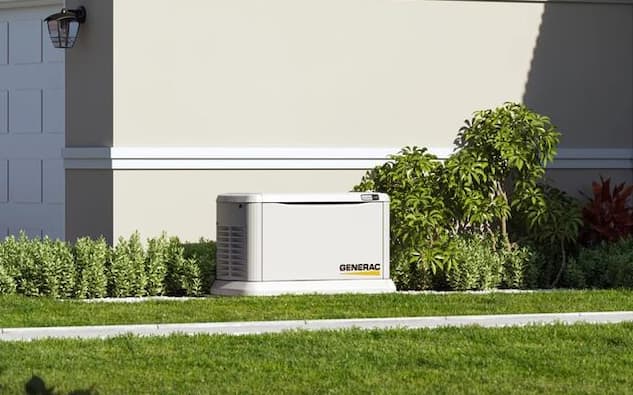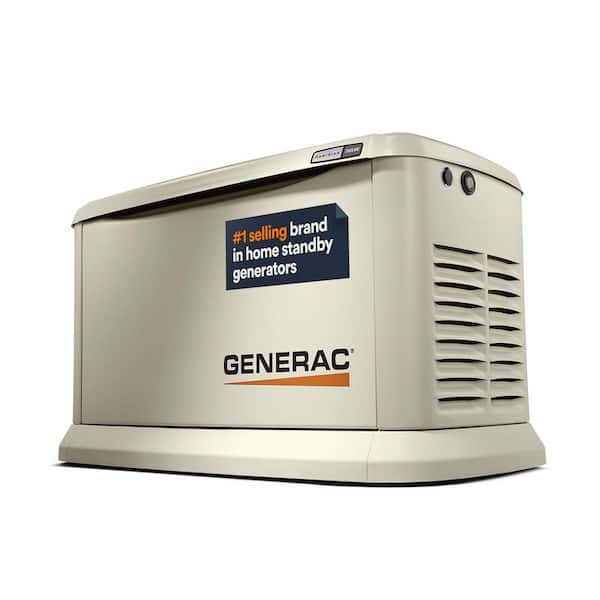

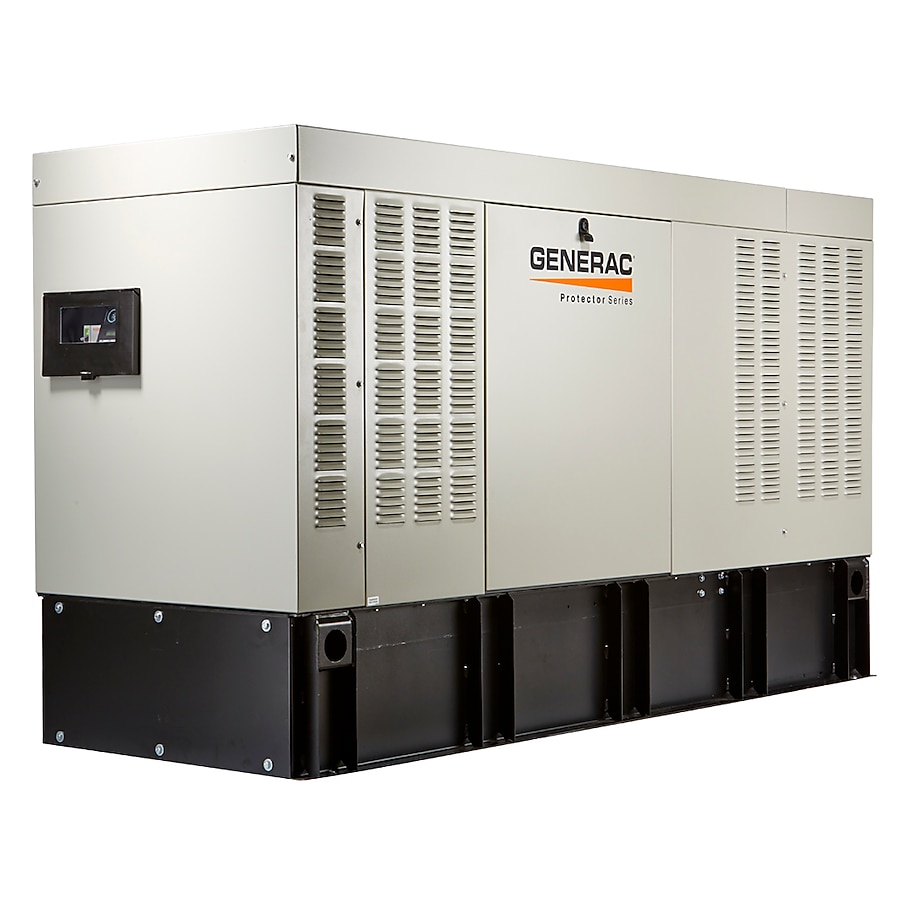
"Commercial generator" is a marketing category, not an engineering one. Plenty of businesses run 22 kW air-cooled units and plenty of large homes run liquid-cooled machines that a catalog would call commercial.
The distinction that actually predicts cost, noise, maintenance and lifespan is how the engine is cooled.
Air-cooled: the residential standard
Roughly 7–26 kW. A fan moves air over finned cylinder heads, the same way a lawn tractor or an older motorcycle engine works.
- 3,600 rpm — the engine spins at twice the speed of a typical liquid-cooled unit to produce 60 Hz from a two-pole alternator.
- Automotive-derived V-twin engines, typically 750–1,000cc.
- Compact and light — a 22 kW unit weighs roughly 400–500 lb and fits a 4×3 ft pad.
- 62–67 dBA at 23 feet.
- $8,000–$15,000 installed for a whole-home system.
- Service every 100–200 hours or annually — oil, filter, plugs, valve adjustment at interval.
- 15–25 year life with maintenance, at residential run hours.
This is what the great majority of homes should buy, and what the top standby generators guide covers.
Liquid-cooled: a different machine
Roughly 22 kW and up, into the hundreds of kilowatts. Coolant circulates through the block to a radiator, exactly like a car.
- 1,800 rpm typically, using a four-pole alternator. Half the engine speed for the same 60 Hz.
- Larger displacement engines, often 2.4L and up, frequently industrial designs.
- Heavy — a 38 kW unit runs 1,200–1,800 lb and needs a substantial pad.
- Quieter per kilowatt, because 1,800 rpm is inherently less noisy than 3,600, though the absolute figure on a big unit is still significant.
- $15,000–$25,000+ installed for residential-class sizes; large commercial goes far higher.
- Service every 250–500 hours, plus coolant system maintenance.
- 20–30+ years, and thousands of hours of runtime capability.
The 1,800 rpm point is the one people underrate. Halving engine speed roughly halves the wear cycles per hour of operation. That's the core of why liquid-cooled machines last through continuous duty that would consume an air-cooled unit.
Side by side
| Air-cooled | Liquid-cooled | |
|---|---|---|
| Typical range | 7–26 kW | 22 kW to hundreds |
| Engine speed | 3,600 rpm | 1,800 rpm |
| Cooling | Fan over fins | Radiator and coolant |
| Weight (whole-home size) | 400–500 lb | 1,200–1,800 lb |
| Installed cost | $8,000–$15,000 | $15,000–$25,000+ |
| Noise | 62–67 dBA | Quieter per kW, louder absolute on big units |
| Service interval | 100–200 hr / annual | 250–500 hr + coolant |
| Continuous runtime | Days, with oil checks | Weeks |
| Expected life | 15–25 yr residential | 20–30+ yr |
| Fuel consumption | Lower (smaller engine) | Higher (bigger engine) |
| Footprint | ~4 × 3 ft pad | 6 × 4 ft or larger |
The overlap zone: 22 to 26 kW
Both technologies exist here, and it's where the interesting decision lives.
Air-cooled at 22–26 kW is the cost-effective choice for the large majority of large homes. Generac's 26 kW, Kohler's 26 kW and Briggs' 26 kW are all air-cooled and all run a substantial house.
Liquid-cooled at 22–30 kW costs meaningfully more for the same output. You're buying durability, longer runtime capability and lower engine speed — not more power.
When the liquid-cooled unit is worth it at the same kilowatts:
- You expect genuinely long outages — a week or more, regularly.
- Medical equipment makes reliability non-negotiable.
- The property is remote and service response is slow, so you want more margin.
- You plan to stay in the house for decades and value the longer life.
- Noise matters enough that 1,800 rpm is worth paying for.
When it isn't:
- Typical suburban outage profile of hours to a couple of days.
- Budget is a real constraint — the difference buys a lot of other resilience.
- You're being sold on it without a load calculation that requires it.
When a home genuinely needs the commercial class
This is the part where I usually talk customers down rather than up. But there are real cases:
Very large homes — over about 6,000 square feet with multiple HVAC systems. Three or four air conditioning units with simultaneous startup demand is a genuine load, and load management can only sequence so much.
Large properties with distributed loads — a main house plus a guest house, a barn, a shop, a well, and a pool. This is where 30–60 kW becomes a real answer rather than an upsell.
Medical necessity — home dialysis, ventilators, powered mobility, refrigerated medication. Where an outage is a health event, the extra reliability margin has a different value.
Home-based operations — a working farm with livestock ventilation or milk cooling, a commercial kitchen, a server room, refrigerated inventory.
Regions with genuinely long outages — where week-plus restorations are normal rather than exceptional, and the generator's continuous-duty capability is actually exercised.
Three-phase service. If the property has three-phase power (rare residentially, common on farms and shops), you're in liquid-cooled territory by default — air-cooled residential units are single-phase.
When it's an upsell
Be skeptical if:
- No load calculation was performed. Anyone recommending 45 kW without measuring your actual loads is selling, not sizing.
- Load management wasn't discussed. Smart management modules on the AC and water heater frequently let a 22 kW unit cover a house someone quoted 40 kW for. See sizing myths.
- The justification is square footage alone. Square footage is a poor proxy. A 5,000 sq ft home with gas heat, gas water heating and two efficient AC units has a lower peak demand than a 3,000 sq ft all-electric home with a heat pump.
- "Bigger is safer" is the argument. Oversizing costs more to buy, more to run, and on some engines causes wet stacking from chronic light loading.
I've replaced 40 kW quotes with 22 kW units plus $600 of load management more times than I can count, and the customers were better served.
Practical differences you'll live with
Installation. Liquid-cooled units need a larger, engineered pad, a bigger gas supply, larger conductors, and often a crane or heavy equipment to set. Installation costs scale accordingly.
Space and clearance. NFPA 37 clearances apply to both, but a 6 × 4 ft machine with a required envelope around it needs real yard. On a compact suburban lot, this alone can decide the question.
Fuel. A bigger engine burns more fuel. On natural gas that's a running cost; on propane it's also a tank-sizing problem. A 48 kW unit on propane goes through a 500-gallon tank considerably faster than a 22 kW one — see fuel comparison.
Service. Longer intervals, but each service is more involved and more expensive, and includes coolant system work. Confirm before purchase that a dealer within reasonable distance actually services liquid-cooled units — not every residential dealer does.
Permits and review. Larger installations more often trigger additional review, setback scrutiny, and in some jurisdictions noise studies. Permits and code requirements.
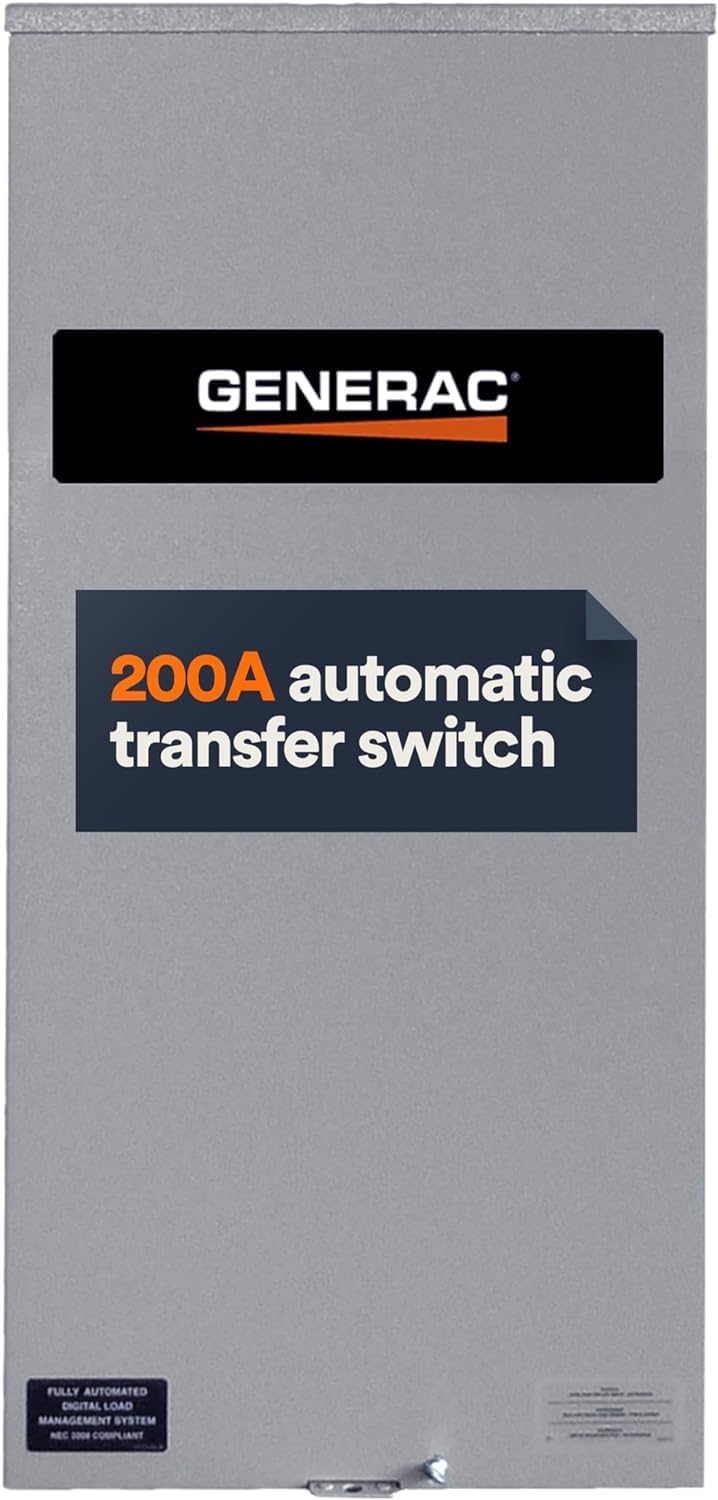
Transfer equipment. Bigger units need appropriately rated transfer switches, and services above 200 amps need a matching switch. That's real cost. See transfer switches.
How to decide
- Get a real load calculation. Not a rule of thumb, not square footage. An actual measurement of your connected loads and starting demands, done by someone who will size from it.
- Ask about load management explicitly. How much smaller a unit could you buy with modules on the AC and water heater? Get the number.
- Define your worst realistic outage. Hours, or a week? That determines whether continuous-duty capability matters.
- Check dealer capability. If you go liquid-cooled, confirm someone nearby services them — and ask about response time in a regional event.
- Compare total cost, not equipment cost. Liquid-cooled installation, fuel, service and transfer equipment all cost more. The gap over fifteen years is larger than the gap at purchase.
- Get quotes for both if you're near the line. A 26 kW air-cooled quote next to a 30 kW liquid-cooled quote makes the tradeoff concrete.
The bottom line
Most homes — including most large ones — are correctly served by a 20–26 kW air-cooled unit with load management. That's not a compromise; it's the right engineering answer for a machine that runs 20 hours a year.
Liquid-cooled makes sense for very large or multi-building properties, genuine three-phase service, medical-necessity installations, regions with routinely long outages, and owners who want decades of service life and will pay for it.
Be skeptical of any recommendation above 26 kW that doesn't come with a load calculation showing why. That's the single question that separates honest sizing from an upsell, and it's the one to ask first.
If you're comparing dealers, how to choose a reliable generator dealer covers what to look for.
Large-home air-cooled optionsAd
The 22–26 kW class that covers most large homes, plus a service-rated transfer switch.
Paid links · As an Amazon Associate, GenDealers earns from qualifying purchases.