
There's a sentence I heard on ride-alongs more times than I can count: "Get the biggest one you can afford — you'll never regret having extra."
It sounds like prudence. It's usually a $3,000 mistake, and occasionally a mechanical one. Let me take the myths in order.
Myth 1: "Bigger is always safer"
Oversizing has four real costs.
Money up front. Stepping from 14 kW to 22 kW adds roughly $2,000–$4,000 installed. On a 26 kW unit you may also need a larger gas line, which adds more.
Fuel, forever. A generator's consumption tracks its size and load. A 22 kW unit at half load burns meaningfully more per hour than a 14 kW unit at three-quarter load doing identical work. Over a multi-day outage — or years of weekly exercise cycles — it adds up.
Wet stacking. This is the mechanical argument, and it's real. An engine running at very light load never reaches proper operating temperature. Unburned fuel and carbon accumulate on cylinder walls, valves and the exhaust. On diesels it's dramatic (raw fuel literally weeping from the exhaust); on air-cooled gas units it's slower but shows up as carbon buildup, fouled plugs and reduced life. A generator loafing at 15% load for years is not being pampered — it's being neglected in a different way.
A larger footprint. Bigger units are physically larger, heavier, need a bigger pad, and are harder to site within the required clearances on a tight lot.
The right target is a generator that runs at roughly 50–80% of capacity during a real outage. That's where engines are happiest and fuel curves are most efficient.
Myth 2: "Add up everything and buy that"
Add every nameplate watt in your house and you'll arrive at 40 kW for a home that never draws more than 12. Nothing in a real house runs simultaneously: the AC cycles, the well pump runs for ninety seconds, the microwave for two minutes, the dryer on laundry day.
The correct method — the one the sizing calculator implements — is:
Realistic simultaneous running load + the single largest starting surge + about 20% headroom
Not the sum of everything. Not the sum of every starting watt. See Kilowatts vs Amps for the worked arithmetic.
Myth 3: "Square footage tells you the size"
Square footage is a proxy for how much stuff a house has, and it's a weak one. What actually matters:
- Heating fuel. Gas furnace: the blower draws 800 W. Electric resistance heat: 10,000–20,000 W. That single difference can double the generator.
- Water heating. Gas: nothing. Electric: 4,500 W.
- Cooking. Gas range: negligible. Electric range: 3,000–5,000 W.
- Air conditioning tonnage, which correlates with square footage but varies enormously with insulation, climate and equipment age.
- Well pump. A rural 2,000 sq ft home with a 1.5 HP submersible has a harder starting load than a 4,000 sq ft suburban home on city water.
I've sized 4,500 sq ft homes at 18 kW (gas everything, one efficient AC) and 1,900 sq ft homes at 24 kW (all-electric with a heat pump and a well). Square footage told me nothing useful in either case.
Myth 4: "Load management is a compromise"
This is the myth that costs homeowners the most money, and it's backwards.
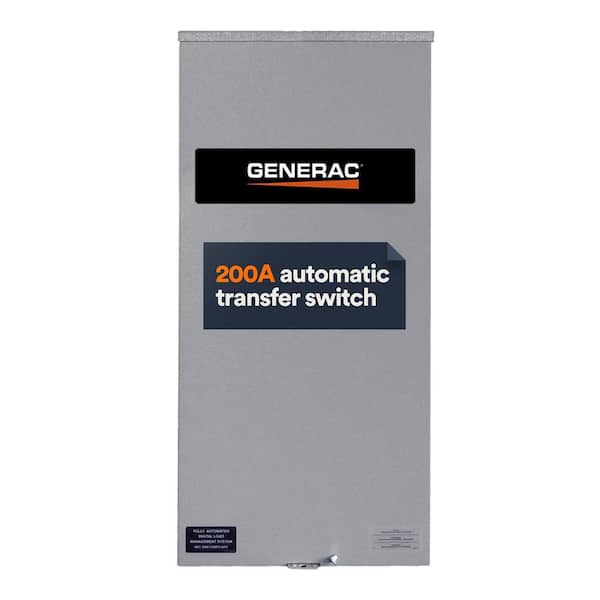
A load-management module watches generator output and temporarily sheds a designated large load when demand approaches capacity. The AC pauses for ninety seconds while the well pump runs. The water heater drops out for two minutes during dinner prep. You do not notice, because water heaters hold heat for hours and a house doesn't warm measurably in ninety seconds.
Manufacturers all offer it: Generac's Smart Management Modules, Kohler's integrated load shed, Briggs & Stratton's Symphony II (up to eight loads), Champion's demand control.
The arithmetic:
| Approach | Equipment | Installed cost | Result |
|---|---|---|---|
| Buy up a size | 22 kW instead of 14 kW | +$2,000–$4,000 | Handles peak brute force; runs at low load most of the time |
| Manage the load | 14 kW + 2 SMM modules | +$200–$500 | Handles peak by sequencing; runs in its efficient band |
Same outcome for the homeowner. Roughly $2,000–$3,500 difference. Load management is not a compromise; it's the engineered solution, and it's what commercial installations have done for decades.
Myth 5: "Nameplate kW is what you get"
Two derates apply, and both are routinely ignored in quotes.
Fuel derate. Natural gas carries less energy per unit volume than propane. The same engine produces roughly 8–10% less on natural gas. A "22 kW" unit is about 19.5 kW on gas; Cummins publishes the RS20A honestly as 20 kW LP / 18 kW natural gas; Champion's 14 kW aXis is 12,500 W on natural gas. If natural gas is your fuel, size against the natural gas number.
Altitude and temperature derate. Air-cooled engines lose roughly 3% of output per 1,000 feet of elevation, and lose capacity in high ambient temperatures. In Denver, on a 100°F afternoon, a 22 kW unit isn't making 22 kW. If you're above about 3,000 feet or routinely above 95°F, discuss derating explicitly with your dealer — see preventing overheating in hot climates.
Myth 6: "Undersizing will damage the generator"
Modern standby units protect themselves. Overload the generator and the controller sheds the load or shuts down cleanly — it doesn't melt. The failure mode of an undersized generator is nuisance, not destruction: it trips when too much starts at once, and you learn to stagger loads.
That said, chronic overload is a bad way to live, and there's a middle ground people miss: undersize deliberately and manage the load. A 14 kW unit with two management modules on a house that "needs" 22 kW is a well-engineered system. A 14 kW unit with no management on that same house is an annoying one.
Right-sizing in practice: three houses
House A — 2,200 sq ft, gas heat/water/range, one 3-ton AC, city water. Running load about 6.5 kW; largest surge is the AC at 11 kW. Naive answer: 22 kW. Right answer: 14 kW with the AC on a management module, or 14 kW plus a soft starter. Saves about $2,500.
House B — 3,400 sq ft, heat pump, electric water heater, two AC compressors, city water. Running load about 11 kW with genuine electric heat demand. Right answer: 22 kW with the water heater managed. This house genuinely needs the size — electric heat is the reason.
House C — 1,900 sq ft, gas heat, 1.5 HP well pump, one 2.5-ton AC. Running load about 5 kW, but the well pump surges to 8 kW and the AC to 9 kW. Right answer: 14 kW with both managed so they can't start together, or 18 kW without management. The well pump — not the square footage — is the story. See powering well pumps.
How to get the sizing right
- Do a real load inventory. Walk the house, read nameplates, note the AC tonnage from the outdoor unit's data plate.
- Decide what you actually want during an outage. Whole house? Whole house minus the hot tub? Essentials plus AC? This is a values question, not an engineering one.
- Identify the largest starting load and ask whether it can be soft-started or managed.
- Run the numbers in the sizing calculator.
- Make dealers show their calculation. A dealer who sizes from the driveway is guessing, and their guess is reliably on the high side — bigger units carry bigger margins.
- Ask specifically: "What would it take to do this job one size down with load management?" The answer tells you a great deal about the dealer.
Right-sizing is not about buying the smallest thing that works. It's about buying the unit that runs in its efficient band, costs what the job actually requires, and doesn't spend twenty years loafing at 15% load waiting for a storm.
Right-sized units and load managersAd
From essentials-only backup up to 22 kW, plus 100-amp load management.
Paid links · As an Amazon Associate, GenDealers earns from qualifying purchases.