

Almost every sizing mistake I’ve seen traces back to one confusion: mixing up the capacity of your electrical service with the load your house actually draws. They are different numbers, and only one of them determines what generator you need.
Your panel says 200 amps. That is the maximum the utility will let you pull — a ceiling, not a measurement. The average American home actually draws somewhere between 5 and 15 amps most of the time, spiking to perhaps 60–80 amps on a hot afternoon with the AC running, the oven on and the dryer going.
That gap is why a 200-amp home does not need a 200-amp generator. Let’s build the arithmetic from the bottom.
The three quantities
Volts (V) — electrical pressure. U.S. homes get 240 volts split into two 120-volt legs. Lights and outlets are 120 V; ranges, dryers, water heaters, well pumps and AC compressors are 240 V.
Amps (A) — the rate of flow. This is what wires and breakers are sized for, because current is what makes conductors hot.
Watts (W) — the actual work being done. This is what generators are sized by, and it is the product of the other two:
Watts = Volts × Amps — and going the other way, Amps = Watts ÷ Volts
A kilowatt (kW) is 1,000 watts. So:
- A 22 kW generator at 240 V delivers 22,000 ÷ 240 ≈ 92 amps
- A 14 kW generator at 240 V delivers 14,000 ÷ 240 ≈ 58 amps
- A 10 kW generator at 240 V delivers 10,000 ÷ 240 ≈ 42 amps
Look at that first line again. The biggest air-cooled residential generator most people buy supplies less than half of a 200-amp service. It works anyway — because you never use the whole service at once. That is the entire premise of home standby sizing.
Running watts vs starting watts
Here is the part that trips up spreadsheets.
Anything with a resistive load — an incandescent bulb, a toaster, a resistance heater — draws the same power the instant it turns on as it does an hour later. Simple.
Anything with a motor — refrigerator compressor, well pump, air conditioner, furnace blower, sump pump — draws a large surge for a fraction of a second while the rotor gets moving. That inrush is typically two to three times the running draw, and on hard-starting compressors it can be more.
| Appliance | Running watts | Starting watts |
|---|---|---|
| LED lighting (whole house) | 200–400 | same |
| Refrigerator | 700 | 2,200 |
| Chest freezer | 500 | 1,500 |
| Furnace blower (1/2 HP) | 800 | 2,350 |
| Sump pump (1/2 HP) | 1,050 | 2,150 |
| Well pump (1 HP submersible) | 2,000 | 6,000 |
| Central AC, 2-ton | 2,500 | 8,000 |
| Central AC, 3-ton | 3,500 | 11,000 |
| Central AC, 5-ton | 5,500 | 17,000 |
| Electric water heater | 4,500 | same |
| Electric range (one element + oven) | 3,000–5,000 | same |
| Electric dryer | 5,400 | 6,750 |
| Microwave | 1,000 | same |
| Internet, computers, TV | 300–600 | same |
The rule that matters: your generator must supply the total running load plus the single largest starting surge, because motors don’t all start at the same instant. You don’t add every starting watt together — you add the biggest one.
Worked example: a real house
Let’s size a generator for a 2,600 sq ft home with gas heat, gas water heater, gas range and one 3-ton central air conditioner.
Step 1 — list what you actually want running during an outage.
| Load | Running W | Starting W |
|---|---|---|
| Refrigerator | 700 | 2,200 |
| Chest freezer | 500 | 1,500 |
| Furnace blower | 800 | 2,350 |
| Sump pump | 1,050 | 2,150 |
| Central AC, 3-ton | 3,500 | 11,000 |
| Lighting (LED) | 400 | 400 |
| Internet, TV, computers | 500 | 500 |
| Microwave | 1,000 | 1,000 |
| Garage door, misc outlets | 550 | 800 |
| Total running | 9,000 |
Step 2 — find the largest single starting surge. The 3-ton AC: 11,000 W starting versus 3,500 W running, so the extra surge is 11,000 − 3,500 = 7,500 W.
Step 3 — add them. 9,000 running + 7,500 surge = 16,500 watts at the worst instant.
Step 4 — add headroom. Most manufacturers and I both like about 20% for future loads and so the engine isn’t pinned at maximum: 16,500 × 1.2 ≈ 19,800 watts ≈ 20 kW.
Step 5 — correct for fuel. On natural gas, a nameplate 22 kW unit produces roughly 19–20 kW. So the honest answer for this house on natural gas is a 22 kW unit — or a 14–18 kW unit with load management, which is the interesting option.
How load management changes the answer
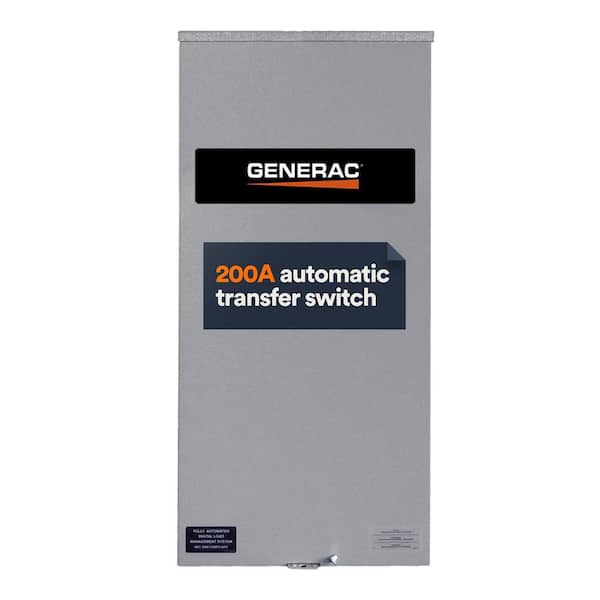
A load-management module (Generac’s Smart Management Modules, Kohler’s load-shed, Briggs’ Symphony II) watches generator output and temporarily sheds a designated large load when the generator approaches capacity. In practice: the AC pauses for a minute while the well pump runs, then resumes. You barely notice.
Rerun the example with the air conditioner managed. Now the generator never has to supply the AC surge simultaneously with everything else, and 9,000 W running + a smaller surge lands comfortably inside a 14 kW unit — sometimes even a 12 kW.
The savings are real: a 14 kW install runs roughly $8,000–$12,000 against $10,000–$14,000 for 22 kW, and the load-management module costs $200–$500. That is why I argue with anyone who tells a homeowner that bigger is automatically safer — see sizing myths for the full argument.
Converting between kW and amps, quickly
Two shortcuts worth memorizing:
- kW → amps at 240 V: multiply by roughly 4.2. (22 kW × 4.2 ≈ 92 A)
- Amps at 240 V → kW: divide by roughly 4.2. (50 A ÷ 4.2 ≈ 12 kW)
For 120-volt circuits, double the amps for the same wattage — a 1,200 W microwave draws 10 A at 120 V but only 5 A at 240 V.
Power factor. Generator specs sometimes list kVA (apparent power) alongside kW (real power). For residential single-phase units the power factor is 1.0, so kW and kVA are the same number. On commercial three-phase equipment they aren’t — a 0.8 power factor means 25 kVA yields 20 kW. If you’re looking at commercial equipment, read the kW number.
Quick sizing table
If you don’t want to do the arithmetic, this is the map I’d use as a starting point — then verify with a real calculation.
| Home | Loads | Generator |
|---|---|---|
| Under 1,800 sq ft, gas appliances, no central AC | Essentials + some comfort | 10–12 kW |
| 1,800–2,500 sq ft, gas heat, one 2–3 ton AC | Whole house with management | 14–18 kW |
| 2,500–3,500 sq ft, one 3–4 ton AC | Whole house | 18–22 kW |
| 3,500–5,000 sq ft, two AC units or electric range + water heater | Whole house | 22–26 kW |
| Over 5,000 sq ft, or all-electric | Whole house | Liquid-cooled 30 kW+ |
Five mistakes to avoid
- Sizing from square footage alone. A 4,000 sq ft house with gas everything can need less generator than a 2,000 sq ft all-electric house.
- Forgetting the natural-gas derate. Roughly 8–10% off the propane rating.
- Adding every starting watt together. Motors don’t start simultaneously; use the largest single surge.
- Ignoring the well pump. Rural buyers routinely underestimate this — a 1 HP submersible wants 6,000 starting watts. See powering well pumps.
- Sizing for a house you don’t have yet. If you might add a hot tub or an EV charger, say so — but don’t buy 26 kW for a hypothetical.
Do it for your house
The sizing calculator does exactly this arithmetic: you add appliances, it tracks running and starting watts, applies the buffer and returns a recommended kW — plus the generators that fit it. Then take that number to two or three dealers and make them show their own load calculation. If theirs differs wildly from yours, ask them to walk you through why. A good dealer will enjoy the conversation.
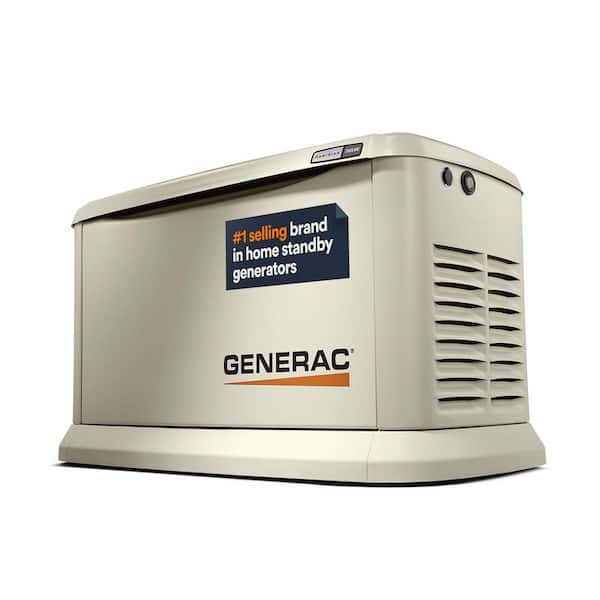
Generators by size, plus load managementAd
Ten, twenty and twenty-two kilowatts, and a load manager for tight sizing.
Paid links · As an Amazon Associate, GenDealers earns from qualifying purchases.