
City customers lose lights. Well customers lose lights, water, toilets, showers and — if they have livestock — the stock tank. That changes the priority of backup power from convenience to necessity, and it changes the sizing math in one specific way.
A submersible well pump is the hardest-starting thing most rural homes own.
Why well pumps are brutal on generators
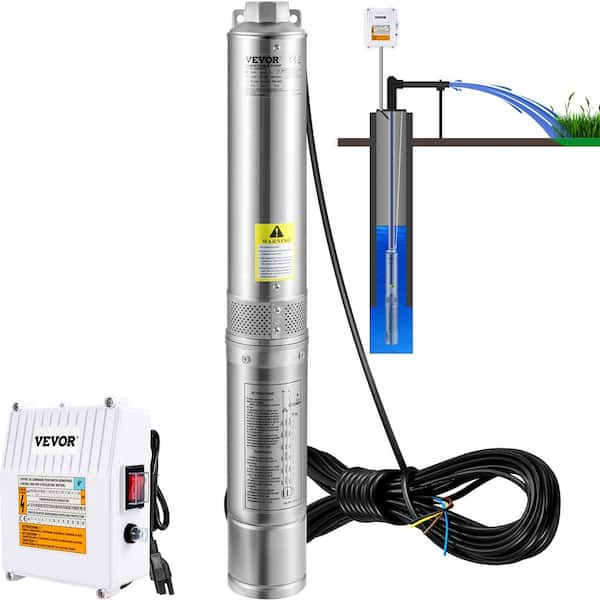
A submersible pump sits at the bottom of the well, often 100 to 400 feet down, and starts against full head pressure — the weight of the entire water column above it. There is no unloading valve, no soft ramp. The motor goes from zero to full speed against that load in about a second, and during that second it draws its locked-rotor current.
| Pump size | Running watts | Starting watts | Typical use |
|---|---|---|---|
| 1/2 HP | 1,000 | 3,000 | Shallow well, small home |
| 3/4 HP | 1,500 | 4,500 | Common suburban well |
| 1 HP | 2,000 | 6,000 | Most common rural size |
| 1.5 HP | 2,800 | 8,400 | Deep well or high demand |
| 2 HP | 3,700 | 11,100 | Deep well, irrigation, livestock |
| 5 HP | 8,500 | 25,000+ | Agricultural / multiple homes |
Compare that to a 3-ton central air conditioner at 11,000 starting watts and you see the problem: a rural home often has two loads competing to be the sizing driver, and if they can start simultaneously, you're sizing for both.
That's how homeowners end up quoted a 26 kW generator for a 1,900 square foot house.
Know which pump you have
Before you plan anything, find out whether your pump is two-wire or three-wire. This determines what solutions are available.
Two-wire pumps have the starting capacitor and relay built into the motor, downhole. Two conductors plus ground run to the pump. Simpler, fewer surface components — but you cannot add a surface soft starter, because the starting components aren't at the surface. Your options are a bigger generator, load management, or replacing the pump with a three-wire or VFD-driven unit when it eventually fails.
Three-wire pumps use a surface-mounted control box containing the capacitor and relay. Three conductors plus ground. You can add a soft starter at the control box, and this is the common, inexpensive fix.
How to tell: look for a control box (a small metal or plastic box, usually in the well house, basement or near the pressure tank). If one exists, you have a three-wire pump. If the pump wiring runs straight from a breaker to the well head with no box, it's likely two-wire. A well contractor can confirm in five minutes, and it's worth the call before you buy a generator.
The four ways to solve the surge
1. Soft starter — best value for three-wire pumps
A soft starter ramps voltage over one to three seconds instead of applying it instantly, reducing inrush by 50–70%. Cost is roughly $300–$800 installed. It also reduces mechanical shock on the pump and plumbing, which extends pump life — a real secondary benefit given that replacing a submersible means pulling several hundred feet of pipe.
If you have a three-wire pump and are sizing a generator, price a soft starter first. It frequently pays for itself several times over in generator size.
2. Variable-frequency drive — best performance, higher cost
A VFD (also called a constant-pressure system) varies motor speed continuously, giving a very gentle start and steady house pressure regardless of demand. Cost is $1,200–$2,500 installed, and it usually comes as part of a constant-pressure pump package rather than a retrofit.
Two cautions for generator owners. First, some VFDs are sensitive to generator power quality — check that yours tolerates the total harmonic distortion of your generator (standby units are typically under 5%, which is generally fine; conventional portables at 8–15% may not be). Second, a VFD needs a compatible pump.
Worth it if you're replacing a pump anyway, or if you value constant pressure.
3. Load management — cheapest, works with any pump
A load-management module ensures the well pump and the air conditioner can never start simultaneously, and sheds the AC when the pump calls. At $200–$500, this is the cheapest way to stop two big surges from stacking, and it works with two-wire pumps where a soft starter can't.
For most rural homes, load management on the AC plus a normally sized generator is the correct engineering answer.
4. Bigger generator — the default, and usually the worst value
Buying up a size costs $2,000–$4,000 and burns more fuel forever. Sometimes it's genuinely necessary — a 2 HP two-wire pump with a large AC compressor may leave you no alternative. But it should be the last option considered, not the first one quoted. See sizing myths.
Worked example: a real rural house
2,400 sq ft, propane heat, 1 HP three-wire submersible, one 3-ton central AC, electric water heater.
Running loads: refrigerator 700 + freezer 500 + furnace blower 800 + lights 400 + electronics 500 + water heater 4,500 = 7,400 W (with the water heater as the swing item).
Competing surges: AC 11,000 W; well pump 6,000 W.
Naive approach: assume both could start together, add everything → 24 kW+ generator, roughly $13,000–$16,000 installed.
Engineered approach:
- Soft starter on the well pump → surge drops to about 2,400 W. $500
- Load-management module on the AC and the water heater → they can't stack. $400
- Now the peak instant is 7,400 running (less the managed water heater) + the AC's 11,000 surge, sequenced.
- 14–18 kW generator handles it. Roughly $9,500–$13,000 installed.
Net saving: $2,500–$4,000, plus lower fuel burn for twenty years, plus a pump that starts more gently and lasts longer.
The pressure tank trick
Here's a low-tech improvement most people never consider: a bigger pressure tank means fewer pump starts.
A pressure tank stores water under air pressure so the pump doesn't run every time someone opens a tap. A small 20-gallon tank might hold six usable gallons and cycle the pump constantly; an 85-gallon tank holds roughly 25 usable gallons and cuts pump starts dramatically.
During an outage that matters twice: fewer starts means fewer surges for the generator to absorb, and it means you have water in reserve even in the moments the pump isn't running. Upgrading a pressure tank costs $400–$900 and helps in normal operation too — less cycling means longer pump life.
Transfer switch and wiring notes for rural installs
A few things that differ from suburban jobs:
The well may be on its own circuit far from the panel. Verify that the well pump circuit is actually inside whatever the transfer switch backs up. On an essential-circuits switch, this gets forgotten — people back up the kitchen and the furnace and discover in the first outage that they have no water. If you're using a circuit-selecting switch, the well pump is circuit number one.
Long runs mean voltage drop. If the well is a few hundred feet from the house, conductor sizing matters more than usual — voltage drop on startup makes a hard-starting motor harder.
Separate well houses may have their own sub-panel, which affects where the transfer switch goes and how the bonding is arranged. Get this designed, not improvised.
Livestock and irrigation are loads people forget to mention to the dealer. Stock tank heaters in winter are significant, continuous loads.
What I'd recommend for most rural homes
- Find out if your pump is two-wire or three-wire. Everything follows from that.
- Three-wire → price a soft starter before you price a bigger generator.
- Put the AC and water heater on load management so nothing stacks with the pump.
- Confirm the well circuit is backed up, especially with an essential-circuits switch.
- Consider a larger pressure tank — cheap, helps in every outage and every normal day.
- Then size the generator with the calculator, using the reduced surge numbers.
For the majority of rural homes — one AC compressor, a 1 to 1.5 HP pump, gas or propane heat — that process lands on a 14 to 18 kW standby unit, not the 26 kW that gets quoted when nobody addresses the surge. Spend $900 on a soft starter and a management module instead of $3,000 on kilowatts you'll use for one second at a time.
Higher-capacity units and switchgearAd
For rural homes with pumps, shops and long runs from the panel.
Paid links · As an Amazon Associate, GenDealers earns from qualifying purchases.