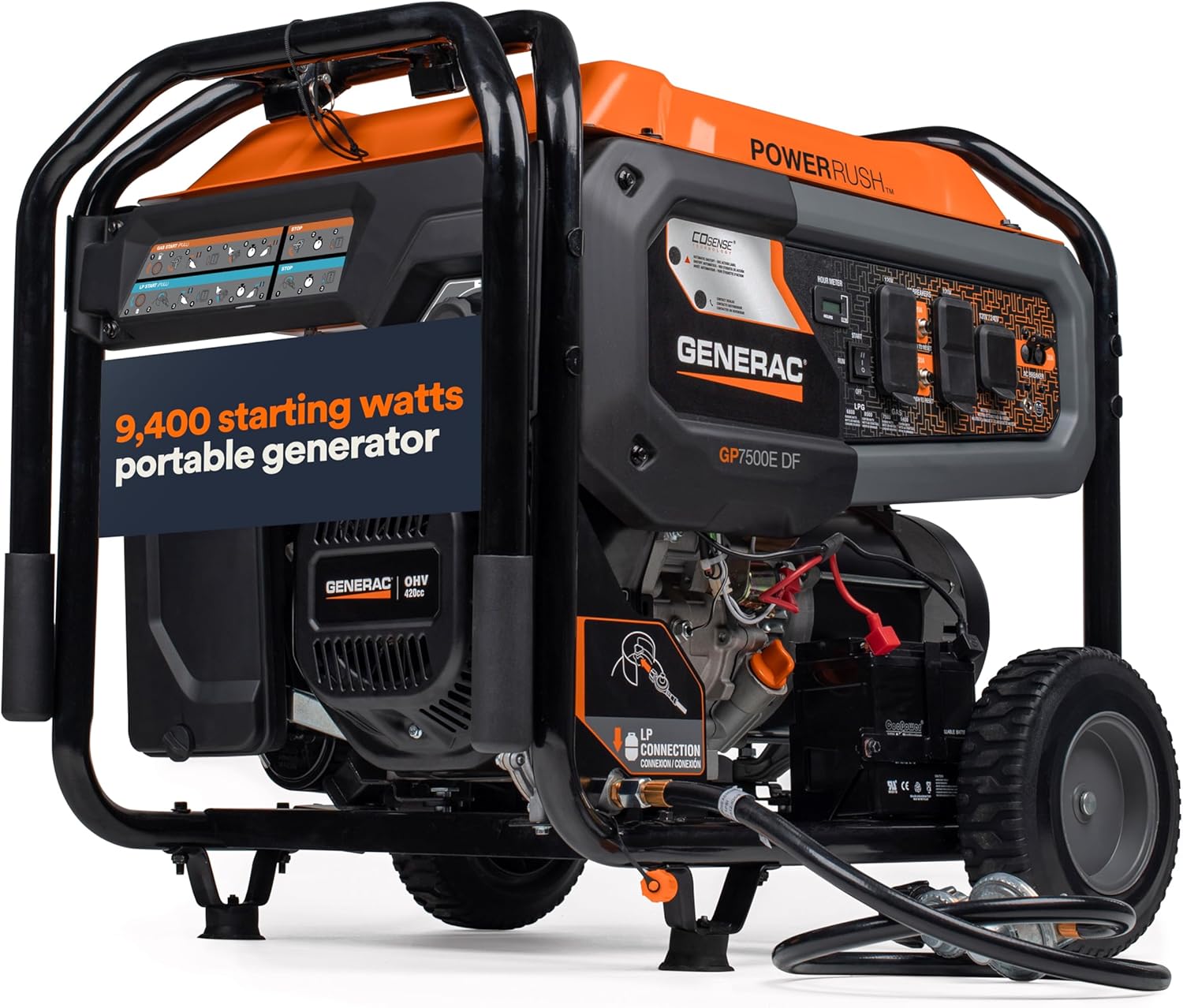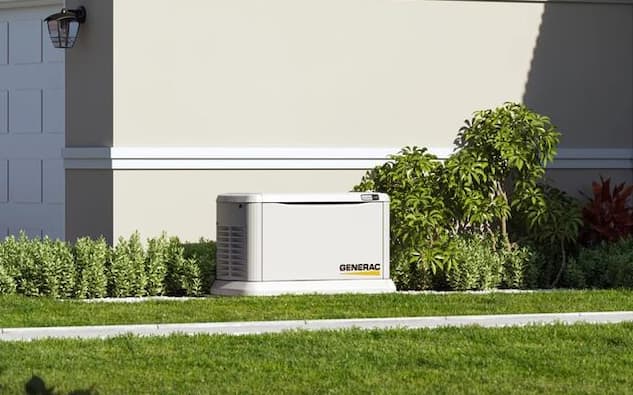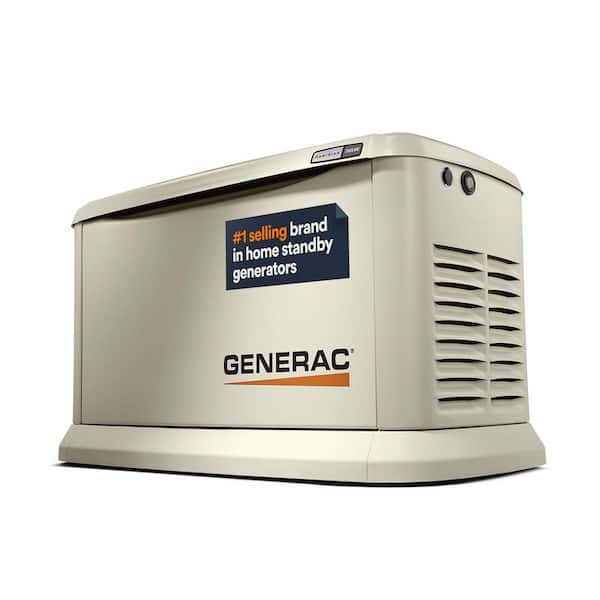

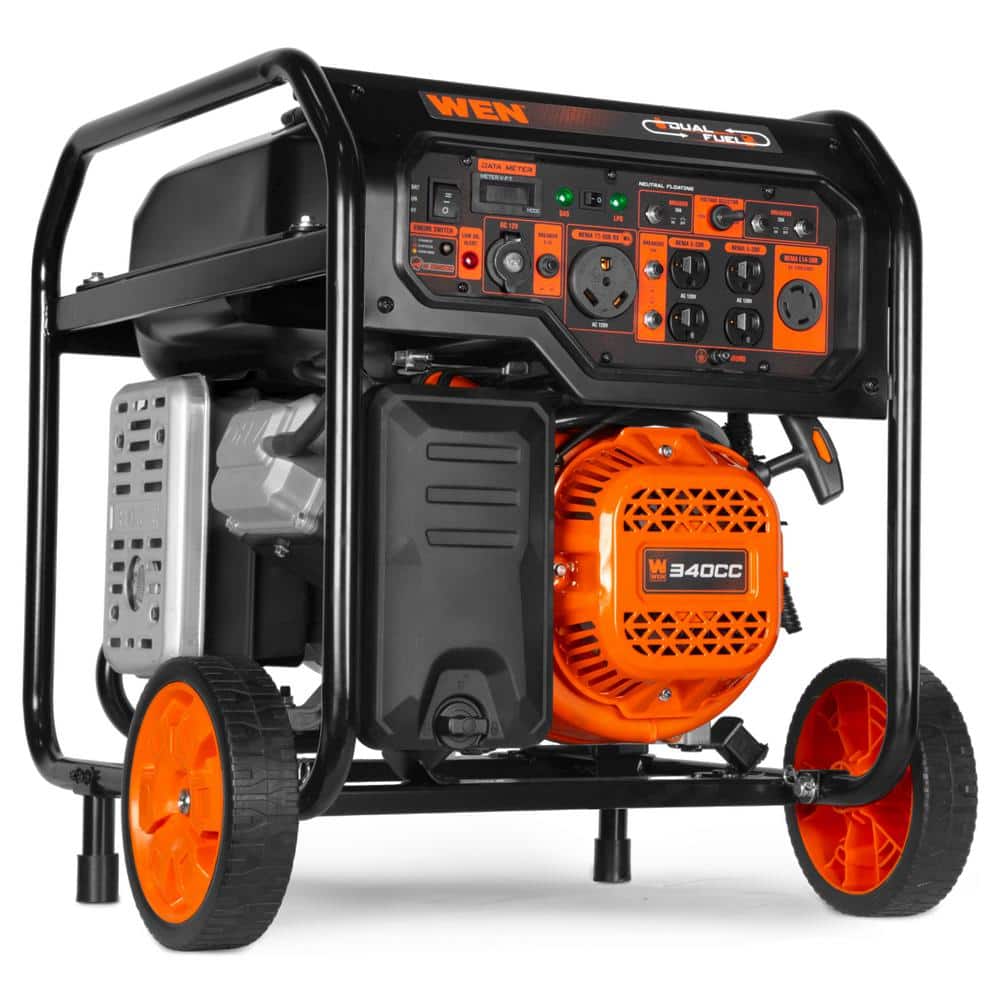
The word “generator” covers four machines that have almost nothing in common except an engine and an alternator. I’ve sold all of them, and the single most common mistake I saw wasn’t buying the wrong brand — it was buying the wrong type. A family that needed a standby unit bought a portable and spent every outage dragging it out of the shed in the rain. A weekend camper bought a 22 kW standby unit for a cabin he visits six times a year.
Here’s how to tell which one you actually need.
The four types
Standby generators are permanently installed outside the house on a pad, plumbed into natural gas or a propane tank, and wired through an automatic transfer switch. They test themselves weekly, start within seconds of an outage, and shut down when utility power returns. You don’t do anything. You may not even be home.
Portable generators are wheeled units with a gasoline (sometimes dual-fuel) engine and a panel of outlets. You roll them out, fill them, start them, and run cords — or, done properly, plug into an inlet box feeding a manual transfer switch. They’re cheap, loud, and require you to be present.
Inverter generators are portables with different electronics. The engine output is rectified to DC and re-synthesized into a very clean AC sine wave, which lets the engine throttle down when loads are light. The result is quieter operation, better fuel economy, and power clean enough for anything you own. They cost more per watt and rarely exceed 7,000 running watts.
PTO generators bolt to a tractor’s power take-off shaft. If you own a tractor with 40+ horsepower, this is a low-cost way to get 10–25 kW during an outage. If you don’t own a tractor, ignore this category.
The comparison that matters
| Standby | Portable | Inverter | PTO | |
|---|---|---|---|---|
| Typical output | 10–26 kW | 3–12 kW | 2–7 kW | 10–25 kW |
| Equipment cost | $4,000–$9,000 | $500–$2,500 | $600–$3,000 | $2,000–$5,000 |
| Installed cost | $8,000–$15,000 | $0 (+$900–$2,500 for a transfer switch) | Same as portable | Requires tractor + switch |
| Starts automatically | Yes | No | No | No |
| Works when you’re away | Yes | No | No | No |
| Fuel | Natural gas / propane | Gasoline / dual fuel | Gasoline / dual fuel | Diesel (tractor) |
| Refueling during outage | Never (natural gas) | Every 8–12 hours | Every 8–12 hours | Tractor tank |
| Noise at 23 ft | 62–67 dBA | 70–80 dBA | 52–62 dBA | Tractor noise |
| Power quality (THD) | Under 5% | 8–15% | Under 3% | Varies |
| Lifespan | 20–30 years | 5–10 years | 5–12 years | Tractor life |
| CO risk | Low (permanently sited outdoors) | High | High | Moderate |
The line in that table that decides most purchases is “works when you’re away.” A portable generator protects your house only if someone is home, awake, and willing to go outside in whatever weather caused the outage. If your pipes freeze or your sump pump stops while you’re at work, the portable in the shed was worth nothing.
Standby generators: the permanent solution
A standby unit is a small power plant that lives in your side yard. It exercises itself weekly (usually a five- to twelve-minute run you’ll learn to ignore), monitors utility voltage continuously, and when the grid drops it starts, waits a few seconds to stabilize, and signals the transfer switch to move your house from utility to generator. Total time in the dark: about ten seconds.
Why they’re worth the money. No fuel to buy or store — natural gas arrives by pipe, and a 500-gallon propane tank runs a 22 kW unit for several days. No cords. No carbon monoxide risk from a machine sitting 18 inches off the wall with its exhaust directed outward, permanently. No decisions at 3 a.m.
What they cost. Equipment runs $4,000–$9,000 depending on size and brand; installed, expect roughly $8,000–$15,000 for the common 14–22 kW range with a 200-amp service-entrance transfer switch, permits, pad, gas line and startup. Our full cost breakdown itemizes it.
The catches. You need a gas supply (or room for a propane tank), a legal location on your property, a permit, and a maintenance habit. Air-cooled units also derate in extreme heat and need a battery that gets replaced every three to four years.
Portable generators: cheap power, real hazards
A 7,500-watt dual-fuel portable costs about $900 and will run a refrigerator, a furnace blower, a sump pump, some lights and a few outlets. For an occasional short outage, that is a completely reasonable answer — and for millions of households it’s the only affordable one.
But portables kill people, and it’s worth being blunt about how. The U.S. Consumer Product Safety Commission attributes roughly 80 to 100 deaths a year to carbon monoxide from portable generators, and since 2008 has counted an estimated 790 non-fire CO deaths — about 43% of all CO fatalities from consumer products in its jurisdiction. Almost every one follows the same pattern: the generator was run in a garage, a basement, a crawlspace, a shed, or on a porch near a window, usually during a storm, usually because moving it further away was inconvenient.
The rules are not complicated:
- Outside only. At least 20 feet from the house. Not the garage with the door open. Not under an overhang.
- Exhaust pointed away from the house and away from neighbors’ windows.
- Working CO alarms on every level of the home, with batteries you’ve tested this season.
- Never refuel a hot engine. Let it cool; gasoline on a hot exhaust is a fire.
- Never backfeed. Plugging a generator into a dryer outlet to energize your panel can kill a lineworker restoring your street, and can destroy your equipment when power returns. Use an inlet box and a transfer switch. Always.
Newer portables sold under the voluntary UL 2201 standard include CO sensors that shut the engine down as levels rise. If you’re buying a portable in 2026, buy one with that feature. It is the single most valuable spec on the box.
The full treatment — the exposure ladder, why an open garage is the deadliest misconception in this subject, and what CO alarms do and don’t catch — is in carbon monoxide safety.
The other honest limits: you’ll refuel every 8–12 hours, including overnight; a 5-gallon can is 5 gallons you had to buy before the storm; and at 70–80 dBA your neighbors will know exactly how prepared you were.
Inverter generators: clean, quiet, smaller
Inverter units solve the two things people hate about portables — noise and dirty power — at the cost of capacity and dollars per watt.
The clean-power part is real and measurable. A conventional portable produces total harmonic distortion around 8–15%; an inverter produces under 3%, which is comparable to (often better than) grid power. Anything with a switching power supply or a variable-speed motor — laptops, modern TVs, high-efficiency furnace blowers, medical equipment, induction ranges — is happier on inverter power. I’ve seen conventional-portable power kill a furnace control board; I’ve never seen inverter power do it.
The quiet part is equally real: 52–62 dBA versus 70–80. That’s the difference between conversation and shouting.
The trade-off is size and price. Inverters top out around 7,000 running watts, and you’ll pay roughly twice per watt what a conventional portable costs. For camping, RVs, tailgating, job sites and short outages where you mainly need to protect electronics and a fridge, they’re the better machine. For whole-house backup, they’re not enough.
PTO generators: only if you already own the tractor
A PTO generator is a bare alternator on a frame that couples to a tractor’s power take-off shaft. Ten to twenty-five kilowatts for $2,000–$5,000 and no engine to maintain, because the tractor is the engine. On a farm with a 50-horsepower tractor sitting in the barn, this is the cheapest serious backup power available.
The limitations are obvious: the tractor has to be running (and fueled) for the whole outage, it has to be there — not in a field, not at the shop — and it needs an operator. You still need a transfer switch. As a supplement to a farm’s power plan it’s excellent; as a household’s only backup, it isn’t.
Which one should you buy?
Answer these in order:
1. How often do you lose power, and for how long? U.S. customers averaged about 11 hours without power in 2024 — nearly double the previous decade’s average, driven by hurricanes. But the average hides everything. If your street loses power twice a winter for six hours, a portable is defensible. If you lose it five times a year, or for days at a time, the standby unit is the honest answer.
2. Is anyone home during a typical outage? If the house is empty on weekdays and you have a sump pump, a freezer, or pipes that can freeze, only a standby unit protects you.
3. Does anyone depend on powered medical equipment? Oxygen concentrator, CPAP, home dialysis, refrigerated medication — that’s a standby generator. Don’t rationalize it.
4. What’s your budget, honestly? A portable plus a properly installed manual transfer switch runs $1,500–$3,500 total and covers the essentials. That’s a legitimate plan, and far better than a portable with extension cords.
5. Do you have gas service or room for propane? No gas and no room for a tank makes a standby unit expensive and complicated.
The short version
- Frequent or long outages, or an empty house during the day → standby generator, 14–22 kW, natural gas, automatic transfer switch.
- Occasional short outages, someone always home, tight budget → dual-fuel portable, 7,500–9,500 watts, plus a manual transfer switch and an inlet box.
- Electronics, RV, camping, job site, small apartment backup → inverter generator, 2,200–5,000 watts.
- Working farm with a tractor → PTO generator as a supplement.
Whatever you choose, the transfer switch is not the place to save money, and the CO rules are not suggestions. I’ve seen the aftermath of ignoring both.
Portable and inverter picksAd
Two portables at different sizes, the manual transfer switch that connects them safely, and a storage cover.
Paid links · As an Amazon Associate, GenDealers earns from qualifying purchases.