
Everything else on this site is about money, convenience and reliability. This one is not.
The U.S. Consumer Product Safety Commission attributes roughly 80 to 100 deaths a year to carbon monoxide from portable generators, and has counted an estimated 790 non-fire CO deaths since 2008 — about 43% of all carbon monoxide fatalities from consumer products in its jurisdiction. For a single product category, that is an extraordinary share.
What makes those numbers worth studying rather than just quoting is how repetitive they are. These are not freak accidents. Almost every one follows the same short list of decisions, made by reasonable people, during a storm, for understandable reasons.
I have never lost a customer to this. I have read enough incident summaries to know exactly how it happens, and I want you to know too.
Why generators produce so much of it
Carbon monoxide is what an engine makes when fuel doesn't burn completely. It is colorless, odorless and tasteless. You cannot smell it, see it, or taste it. Your body actively prefers it to oxygen — hemoglobin binds CO more readily than it binds O₂ — so it displaces the oxygen in your blood while you feel, at first, only slightly unwell.
A portable generator is a small, uncontrolled, spark-ignition engine running under load. It emits CO at a rate wildly out of proportion to its size — a single portable generator can produce as much carbon monoxide as hundreds of idling cars.
That is the fact people get wrong. They reason about a generator the way they reason about a lawnmower or a leaf blower: noisy, smelly, but you stand next to it for an hour and you're fine. A generator is a different animal, because it runs for hours or days, continuously, at load, and is very often placed where the exhaust cannot escape.
In an enclosed or partly enclosed space, a running generator can reach lethal carbon monoxide concentrations within minutes.
The exposure ladder
Carbon monoxide is measured in parts per million. The health effects are well documented and the ramp is steep:
| Concentration | Effect |
|---|---|
| 50 ppm | OSHA's 8-hour occupational exposure limit for healthy adults |
| 70 ppm | Headache, fatigue and nausea after several hours |
| 150–200 ppm | Disorientation, severe headache, loss of consciousness possible |
| 400 ppm | Life-threatening within about three hours |
| 800 ppm | Unconsciousness within about two hours; death within two to three |
| 1,600 ppm | Death within about an hour |
| 6,400 ppm | Death within 10–15 minutes |
| 12,800 ppm | Death within one to three minutes |
Now hold that table next to the previous paragraph. A generator running in an attached garage does not creep up the ladder — it can land you near the bottom of it. That is why "I'll only run it in there for a few minutes" is not a smaller version of the same risk. It is the risk.
The one rule
Outdoors only. At least 20 feet from the house. Exhaust directed away from every door, window and vent.
That is the whole thing. Twenty feet is the CPSC's guidance figure, and the reason it exists is that CO does not stop at the wall — it drifts, it follows air currents, and it enters through openings you are not thinking about.
Three parts, and all three matter:
Outdoors means genuinely outdoors, with open air on all sides and above. See the next section, because this word is where people go wrong.
Twenty feet is a minimum, not a target. Further is better. If your only option is closer than 20 feet, the answer is not "closer will probably be fine" — it is that you need a different plan for this outage.
Exhaust directed away matters as much as distance. A generator 25 feet out with its exhaust pointed at an open basement window is more dangerous than one at 20 feet pointed at the far fence. Know which end the exhaust comes out of, and aim it at nothing.
Where people actually die
This is the part I most want you to read, because "indoors" turns out to be a much larger category than people assume.
The open garage. This is the deadliest misconception in the whole subject, and it is worth being blunt: an open garage is not outdoors. An attached garage with the door fully up still traps carbon monoxide against the ceiling, and it shares a wall — and usually a door, and often ductwork — with your living space. CO accumulates in the garage and migrates into the house. People do this specifically because it is raining, which is precisely when they will be running the generator for two days rather than two hours.
The carport. A roof overhead is enough to trap exhaust even with open sides. Not outdoors.
The covered porch or breezeway. Same problem, and it is adjacent to a door.
The basement or crawlspace. No ambiguity here, and yet it happens — usually to protect the generator from theft or weather.
The shed or detached garage. Enclosed is enclosed, whether or not it is attached to the house.
Under an open window, or beside a vent. The generator is technically outdoors and the CO comes indoors anyway. Bedroom windows and basement windows are the common ones. Fresh-air intakes and dryer vents are the ones nobody thinks of.
Too close to a neighbor's house. Your placement can poison someone else. In dense neighborhoods this is a real and documented pattern.
The common thread: every one of these choices is made for a sensible-sounding reason — rain, theft, noise, cord length, convenience. The reasoning is fine. The outcome is fatal. Which is why the rule has to be absolute rather than judgment-based: if you allow yourself to weigh it case by case, the night will come when the weather is bad and the reasoning wins.
Carbon monoxide alarms
Install them. On every level of the home, and near sleeping areas. Test them monthly. Replace them at the end-of-life date printed on the unit — CO sensors degrade, and an expired alarm is decoration.
And then understand their limits, because this is where people get a false sense of safety:
An alarm is a backup, not a permission slip. It does not make an unsafe placement safe. At the concentrations a generator produces in an enclosed space, the alarm sounds and you may already be too impaired to act on it — confusion and weakness are early symptoms, and they arrive before you decide to leave.
Smoke alarms do not detect CO. Combination units exist and are clearly labeled; a plain smoke alarm gives you nothing here.
Battery-only alarms need working batteries — and outages are exactly when people discover theirs are dead. Check them at the start of storm season, not during the storm.
Placement matters. Follow the manufacturer's instructions; NFPA guidance covers each level of the home and the area outside sleeping rooms.
If a CO alarm sounds: get everyone outside into fresh air immediately, then call 911 from outside. Do not open windows and investigate. Do not go back in for anything. Leave first, diagnose later.
Symptoms — and the trap in them
Carbon monoxide poisoning presents as headache, dizziness, weakness, nausea, shortness of breath, confusion and blurred vision. It is frequently described as flu-like — but without a fever.
The trap is that the symptoms impair exactly the faculty you need to recognize them. Confusion and drowsiness are the mechanism by which people fail to leave. Someone mildly poisoned decides to lie down.
Two rules that cut through it:
- If several people — or the pets — feel unwell at the same time, in the same building, get out. Simultaneous onset is the tell.
- If symptoms improve when you go outside and return when you go back in, that is carbon monoxide until proven otherwise.
Get into fresh air, call 911, and let medical people rule it out. CO poisoning is treatable, and it is diagnosed with a blood test in minutes.
Safer portable equipment
Since roughly 2018, industry voluntary standards have introduced two genuine improvements, and CPSC has reported on both — including on how uneven manufacturer compliance has been.
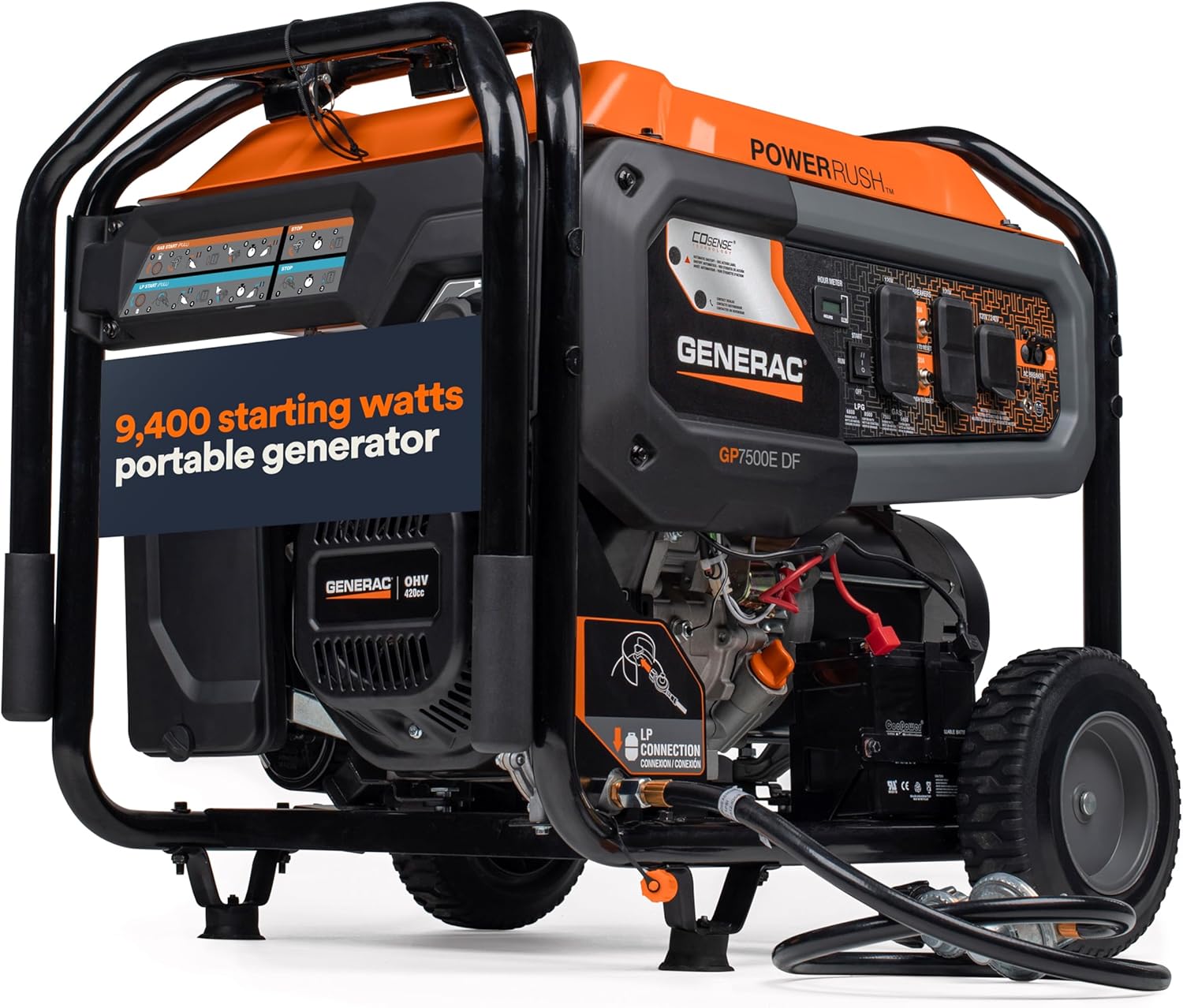
CO shutoff sensors. The generator detects rising carbon monoxide around it and shuts itself down. Marketed under names like CO Guard, CO Shield, CO Sense and CO Detect.
Reduced-emission engines. Engine and exhaust changes that lower CO output substantially at the source.
If you are buying a portable, buy one with a CO shutoff sensor. It is worth the premium and there is no reasonable argument against it.
But hold two things in mind at once: the feature is a last line of defense, not a substitute for placement. It exists to catch the case where someone has already made the fatal decision. Buying one does not make the garage acceptable.
Why permanent standby generators are safer
This is not marketing. It is the structural reason I recommend permanent installations to anyone whose outages are more than occasional.
A portable generator asks you to make a placement decision every single time, often at night, in bad weather, under stress, possibly after the outage has already been going for a day. Human beings make bad decisions under exactly those conditions. The safety of the system depends on your judgment at the worst possible moment.
A permanently installed standby generator makes that decision once, and it is made by a licensed installer against code:
- Sited at manufacturer and NFPA 37 clearances from the structure.
- Positioned specifically away from doors, windows, soffit vents and fresh-air intakes.
- Exhaust routed outward by design.
- Inspected by the jurisdiction before it is energized.
- And you never touch it again — it starts and stops on its own.
No cords, no dragging it out, no choosing where it goes at 2 a.m. in the rain. The decision that kills people has been removed from the system.
Rules for anyone running a portable
If a portable is what you have, these are non-negotiable:
- Outdoors only. Never in a garage, carport, porch, shed, basement or crawlspace — open door or not.
- At least 20 feet from the house, further if you can.
- Exhaust pointed away from every door, window, vent and intake — yours and your neighbors'.
- CO alarms on every level, tested, with fresh batteries before storm season.
- Never refuel a hot or running engine. Shut it down and let it cool. This is a burn and fire rule rather than a CO one, but it belongs on the same list.
- Do not run it under a tarp or a canopy to keep the rain off. Use a purpose-built generator cover designed for operation with proper clearance, or don't run it.
- Never backfeed through a dryer outlet or a double-male cord. Use an interlock kit or transfer switch installed by an electrician — see transfer switches explained.
- Buy one with a CO shutoff sensor when you replace it.
- Tell everyone in the house where the generator is and what the alarm means.
- If anyone feels unwell, go outside first and ask questions second.
What to do right now
Whatever backup power you have, three things are worth doing today rather than during the next outage:
- Test your CO alarms, and check the end-of-life date printed on each one. If you don't have alarms on every level, that is a $60 fix and it is the highest-value thing in this article.
- Decide your generator's placement in advance — walk outside, pick the spot, measure the distance, note which way the exhaust will face. Making this decision in daylight, calmly, is the entire point.
- If you're weighing portable versus standby, weigh this alongside the cost. The convenience argument for standby is real; the safety argument is stronger and much less discussed. See generator types compared.
Carbon monoxide deaths from generators are almost entirely preventable, and the prevention is not complicated or expensive. It is one sentence — outdoors, 20 feet, exhaust away — held to absolutely, especially on the night when there is a good reason not to.
Standby and portable optionsAd
Permanently installed units, plus portables — check any portable listing for a CO shutoff sensor before buying.
Paid links · As an Amazon Associate, GenDealers earns from qualifying purchases.