
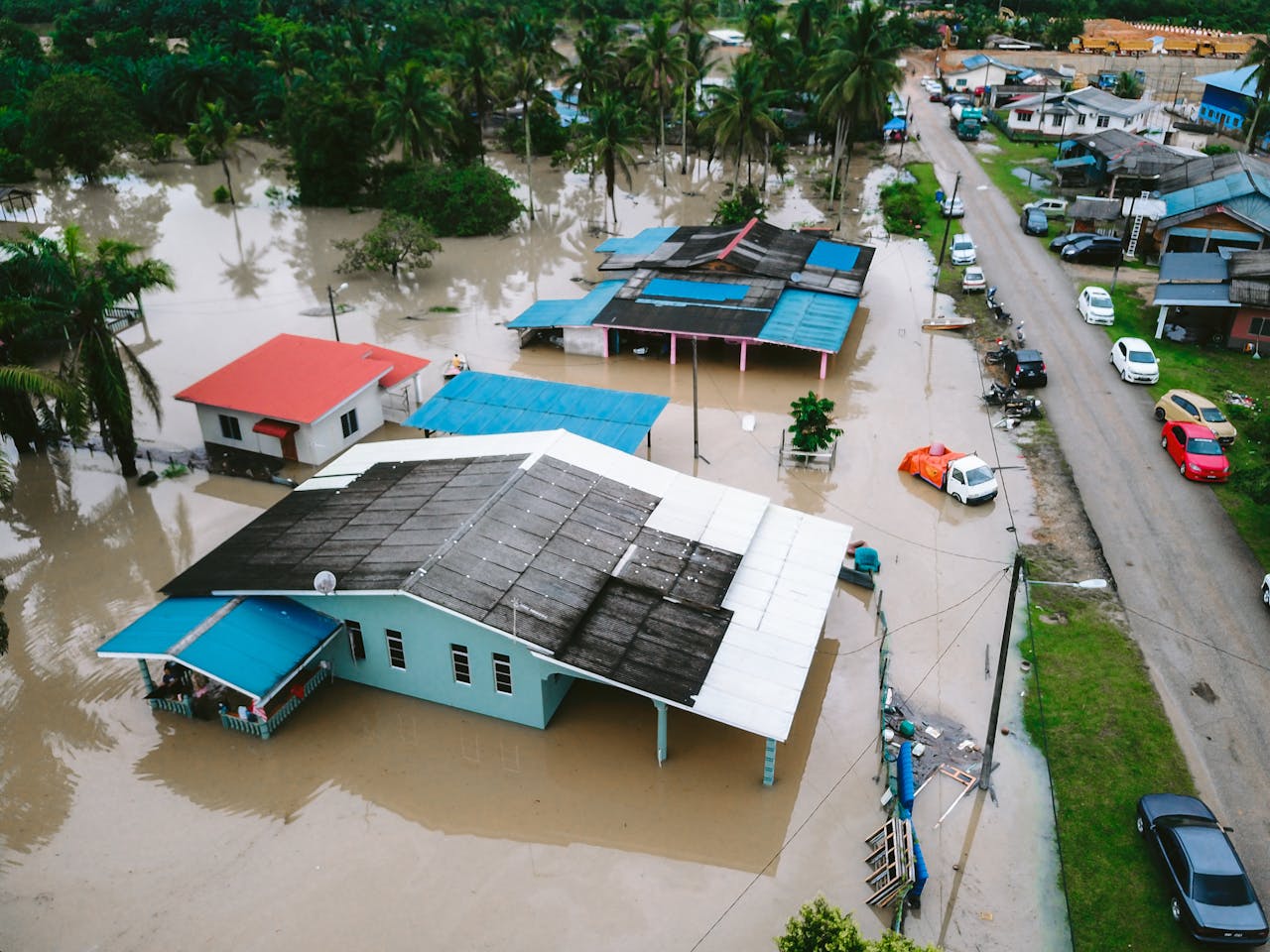
The worst service call of my career was after a hurricane on the Gulf Coast. A homeowner had spent about $12,000 on a 22 kW standby unit eight months earlier. The storm surge came up four feet in his side yard. The generator ran until water reached the intake, then hydrolocked and died.
It was a total loss. The engine had ingested salt water, the alternator windings were soaked, and the controller was scrap. Insurance treated it as flood damage — which his homeowner's policy excluded and his flood policy covered only partially, because it was equipment outside the building envelope.
He'd asked the installer about flooding. The installer said "it'll be fine, it's rated for outdoor use." Outdoor-rated means rain. It does not mean submersion, and nothing you can buy for a house does.
If you live anywhere water can reach, placement is the most consequential decision in the project.
Step one: know your actual flood risk
Before you pick a spot, get three numbers:
- Your flood zone. Look up your address on the FEMA Flood Map Service Center. Zones AE, A, VE and V are Special Flood Hazard Areas; X is outside the 1% annual-chance floodplain but is not "no risk."
- Your Base Flood Elevation (BFE) — the elevation floodwater is expected to reach in the 1% annual-chance (100-year) event, in feet above sea level.
- Your local freeboard requirement. Many jurisdictions require equipment above BFE + 1 or + 2 feet. Your floodplain administrator (usually in the building department) will tell you, and their number governs.
Then add local knowledge the maps don't have: where does your yard pond after a heavy rain? Where did water reach in the last bad storm? Which way does the ground drain? I've seen properties in Zone X flood repeatedly because of a poorly graded neighboring lot. Ask the neighbors who've been there twenty years.
Step two: elevate, correctly
Elevation is the whole game. The options, roughly in order of cost:
Raised concrete pad. A reinforced pad poured to bring the unit above the required elevation. Sound, permanent, and appropriate for a foot or two of elevation. Needs proper footing and reinforcement so it doesn't settle or crack.
Engineered platform or stand. Galvanized or aluminum framing, often used for two to six feet of elevation. Several manufacturers and third parties sell rated stands. Must be engineered for the unit's weight (a 22 kW air-cooled unit is roughly 500 pounds) plus wind and, in coastal zones, hydrodynamic loads.
Elevated deck or structural platform. For substantial elevation — common in coastal Louisiana, coastal Texas and barrier-island construction. This is engineered work with drawings and inspections.
Relocation. Sometimes the cheapest answer is the highest ground on the lot rather than a tall structure on low ground. A longer gas and electrical run costs less than a six-foot engineered platform, and it's more robust.
What doesn't work: stacking concrete blocks, a plywood platform, or a pile of gravel. Inspectors reject these and storms remove them.
Step three: don't trade elevation for clearance
This is where I see well-intentioned installations go wrong. Elevating a unit into a corner, or building a platform with solid skirting, or tucking it under an overhang to keep it out of the weather — all of these choke the airflow that an air-cooled generator absolutely depends on.
The manufacturer's clearances still apply at the elevated position.
Specifically:
- 18 inches minimum from the structure (per most manufacturers' manuals, following NFPA 37).
- 60 inches from any window, door, vent, dryer vent or fresh-air intake — exhaust and carbon monoxide must not be able to enter the house.
- 36 inches of service access in front and at the service side, so a tech can actually work on it.
- 60 inches overhead, and never under a deck, soffit or overhang.
- Open sides. Don't skirt the platform solid; if you screen it for looks, use open lattice and keep the manufacturer's clearance to the screening.
Step four: elevate the fuel and electrical too
Elevating the generator and leaving its support systems at grade is half a job. Water in the transfer switch is as disabling as water in the engine.
- Gas regulator and shutoff above BFE, on a riser, protected from debris impact.
- Transfer switch and disconnect mounted above BFE — this often means relocating them higher on the wall, which is easier during the initial install than afterward.
- Conduit and wiring with drip loops so water runs off rather than following the conductor into an enclosure; sealed penetrations at the wall.
- Battery in its elevated position with the box drained and vented properly.
- Propane tanks are their own topic: an underground tank can float out of the ground when the water table rises unless it's properly anchored, and above-ground tanks must be strapped to an engineered anchor. Your propane supplier knows the local requirement — make them state it.
Coastal and high-wind zones
In hurricane country, flood elevation is only half the requirement.
Wind load. High-velocity hurricane zones (Miami-Dade and Broward in Florida, and similar jurisdictions elsewhere) require equipment with product approval and engineered anchorage — specific anchor bolts, embedment depth and pattern. Your dealer should know the local product-approval regime; if they don't, that's disqualifying.
Salt. Anything within a couple of miles of salt water should have an aluminum enclosure rather than coated steel, and needs a shortened maintenance interval. See coastal generator maintenance.
Debris. Storm surge carries objects. A generator on an exposed platform facing open water may need a debris barrier on the seaward side — placed so it doesn't block airflow.
What to do when water is actually coming
If a flood is forecast and your unit is at risk:
- Shut it down properly. Turn the controller to OFF, and open the generator's circuit breaker at the disconnect.
- Close the fuel supply at the shutoff valve.
- Disconnect the battery if you can do it safely and there's time.
- Do not try to run it as water approaches, hoping to keep the house powered a little longer. That's how you hydrolock an engine.
- Photograph everything — the unit, the pad, the surroundings — before the water arrives, and afterward. Insurance claims turn on documentation.
After the water recedes: do not start it. Not to "see if it works." Water in the cylinders will bend a connecting rod on the first crank. Have a technician inspect it. If flood water reached the enclosure interior, expect a replacement, and expect the discussion with your insurer to hinge on whether you carry flood coverage for exterior equipment.
The honest recommendation
If you're in a Special Flood Hazard Area:
- Get the BFE and freeboard number in writing from your floodplain administrator before selecting a location.
- Elevate to that number, using an engineered platform or a properly designed raised pad.
- Keep manufacturer clearances at the elevated position — verify them physically before the concrete cures.
- Elevate the gas regulator, transfer switch and disconnect.
- Check your insurance specifically: does your flood policy cover exterior mechanical equipment, and at what value? Ask before, not after.
- Consider whether the highest ground on your lot beats an expensive platform on low ground.
The 2024 hurricane season pushed U.S. customers to about 11 hours of outage on average — nearly double the prior decade — with hurricanes responsible for roughly 80% of those hours. Standby generators are worth the most in exactly the storms that carry water with them. Site yours so it's still there when the water goes down.
Whole-home units and protectionAd
Standby generators, the whole-house transfer switch, and panel-level surge protection.
Paid links · As an Amazon Associate, GenDealers earns from qualifying purchases.