
This question comes up every summer, usually phrased as "should I shut it off so lightning doesn't get it?"
The instinct is understandable and the logic doesn't hold. Let me explain what actually threatens a running generator in a severe storm, and then give you the three situations where shutting down genuinely is the right call.
The default answer: leave it running
A standby generator is designed to operate outdoors in weather. The enclosure sheds rain, the air path is designed so water doesn't reach the engine, and the whole point of the machine is to run during the conditions that took the grid down.
Meanwhile, shutting it down costs you the things you need most in a severe thunderstorm:
- The sump pump, during the heaviest rain of the year.
- Refrigeration, which you'll want intact when the storm passes.
- Medical equipment, if anyone depends on it.
- Communications — internet and phone charging while weather warnings are active.
Turning off a generator during a thunderstorm to protect it is a bit like garaging your car during a hailstorm by driving it to a garage across town. You've accepted a certain loss to avoid a possible one.
What lightning actually does
Here's the part that changes the reasoning.
A direct strike on your generator is extraordinarily unlikely — it's a low object, usually beside a much taller house, often near trees. Not impossible, but not the realistic threat.
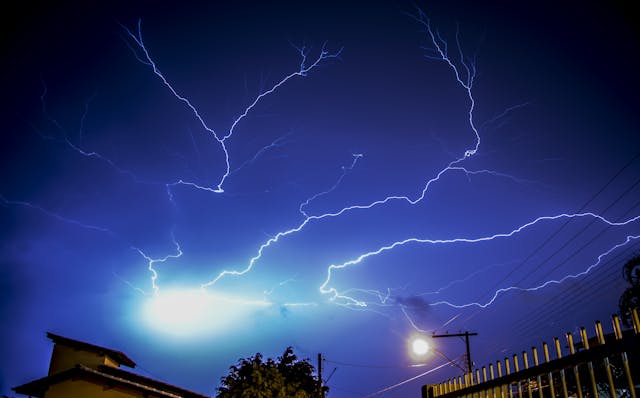
The realistic threat is an induced surge. Lightning striking anywhere nearby — a utility pole down the street, a tree, the ground a hundred yards away — induces a voltage spike on conductors. That spike travels the wiring into your equipment. It's how lightning kills TVs, modems, HVAC boards and, yes, generator controller boards.
And here's the critical point: an induced surge doesn't care whether the generator is running. The controller board is connected to house wiring and to the transfer switch either way. Shutting the generator off doesn't disconnect it from the conductors that carry the surge.
The only way shutting down helps is if you also open the generator's circuit breaker and disconnect it — which takes you outside, in a lightning storm, to do something of marginal benefit. Please don't.
What actually protects it: surge protection
The real answer is a surge protective device (SPD), and it's cheap.
At the main panel. A whole-house Type 2 SPD installed at your main panel clamps incoming surges before they reach branch circuits. Cost: $150–$400 installed, less if done during other electrical work. This is the highest-value storm protection a home with a generator can buy — it protects the generator controller, the transfer switch electronics, the HVAC boards and everything else.
At the generator. Some manufacturers offer an SPD that mounts at or near the unit, protecting the controller specifically.
At the point of use. Good-quality surge strips on electronics, and dedicated protection for anything expensive.
Layered is best. Panel-level plus point-of-use catches what gets through.
Worth knowing: SPDs are sacrificial. They absorb energy and degrade over time, and after a significant strike event they may need replacement. Most have an indicator light — check it after big storms.
For homes in genuinely high-strike regions (central Florida, the Gulf Coast, parts of the Midwest), a full lightning protection system per NFPA 780 — air terminals, down conductors, grounding — is worth discussing with a specialist. That's a building-level decision, not a generator one.
The three times you should shut down
Now the exceptions. These are real, and in each the reasoning is physical damage, not electrical risk.
1. Water is rising toward the unit
This is the clearest case. If flooding is approaching the generator, shut it down properly and isolate it:
- Controller to OFF.
- Open the generator's circuit breaker at the disconnect.
- Close the fuel shutoff valve.
- Disconnect the battery if there's time and it's safe.
- Photograph everything for insurance.
A generator that ingests water while running is destroyed — hydrolocked engine, soaked windings, ruined controller. One that's shut down and dry inside may survive a shallow event. And after the water recedes, do not start it until a technician inspects it. See flood-prone placement.
2. Physical damage or a gas smell
If a tree limb has hit the unit, the enclosure is breached, wiring is exposed, or you smell gas: shut down, close the fuel valve, and stay away. Call the gas utility for a suspected leak. Do not investigate a gas smell with a flashlight and curiosity.
3. Mandatory evacuation
If you're leaving and won't return for days, opinions differ and both are defensible.
Leaving it running keeps refrigeration and the sump pump going while you're away — genuinely valuable in a flood-prone home.
Shutting it down means an unattended engine isn't running for days with nobody to notice a problem, and eliminates any fuel-related risk if the house is damaged.
My own preference: leave it running if the house is not in the flood or surge zone and someone can check on it; shut it down and close the fuel if it's in a surge zone or you'll be gone more than a few days. Whatever you choose, make sure remote monitoring is on so you know what's happening.
What doesn't require shutting down
- Heavy rain. Designed for it.
- High wind — unless debris has struck the unit.
- Hail. Enclosures handle it; check for damage after.
- Nearby lightning. Covered above — surge protection is the answer.
- Extended running. Natural gas can run for days; just check the oil every 24 hours. See how long a generator can run.
Before the storm
- Verify the generator is in AUTO and the exercise cycle ran recently.
- Check the battery if it's been more than three years.
- Clear the clearance envelope of anything that could blow into it.
- Secure loose objects nearby — patio furniture, umbrellas, trash cans — that could strike the unit.
- Top the propane tank if applicable, before the forecast rather than after.
- Confirm SPD indicator lights are showing protected.
- Charge phones and set up monitoring alerts.
After the storm
- Walk around the unit. Debris, dents, displaced components, anything leaning on it.
- Open the enclosure and look inside for water intrusion, nesting material blown in, or damaged wiring.
- Check the controller for stored fault codes and clear them once you understand them.
- Check the SPD indicators. A device that absorbed a big surge may need replacing.
- If it ran for an extended period, check the oil and schedule service if the run exceeded the interval.
- Document any damage with photographs before cleanup, for insurance.
The pattern to internalize: generators are threatened in storms by water and impact, not by running. Protect against surge with hardware, protect against water with placement and a shutdown plan, and otherwise let the machine do the job you bought it for.
Storm-ready backupAd
Monitored whole-home units and a propane-tank monitor.
Paid links · As an Amazon Associate, GenDealers earns from qualifying purchases.