

"How loud is it?" is usually the second question homeowners ask, right after price — and it's often really a question about the neighbors.
The good news is that noise stopped being a meaningful differentiator between the major brands several years ago. Every serious 2026 air-cooled standby unit lands between 62 and 67 dBA at 23 feet. What varies far more than the machine is where you put it and when you run it.
What the numbers mean
Manufacturers publish sound levels at 23 feet (7 meters) — the industry-standard measuring distance. Always check that a quoted figure uses it; a number measured at 50 feet looks better and means less.
| Sound level | Familiar equivalent |
|---|---|
| 40 dBA | Quiet library |
| 50 dBA | Refrigerator hum |
| 60 dBA | Normal conversation |
| 62–67 dBA | Modern standby generator at 23 ft |
| 70 dBA | Vacuum cleaner |
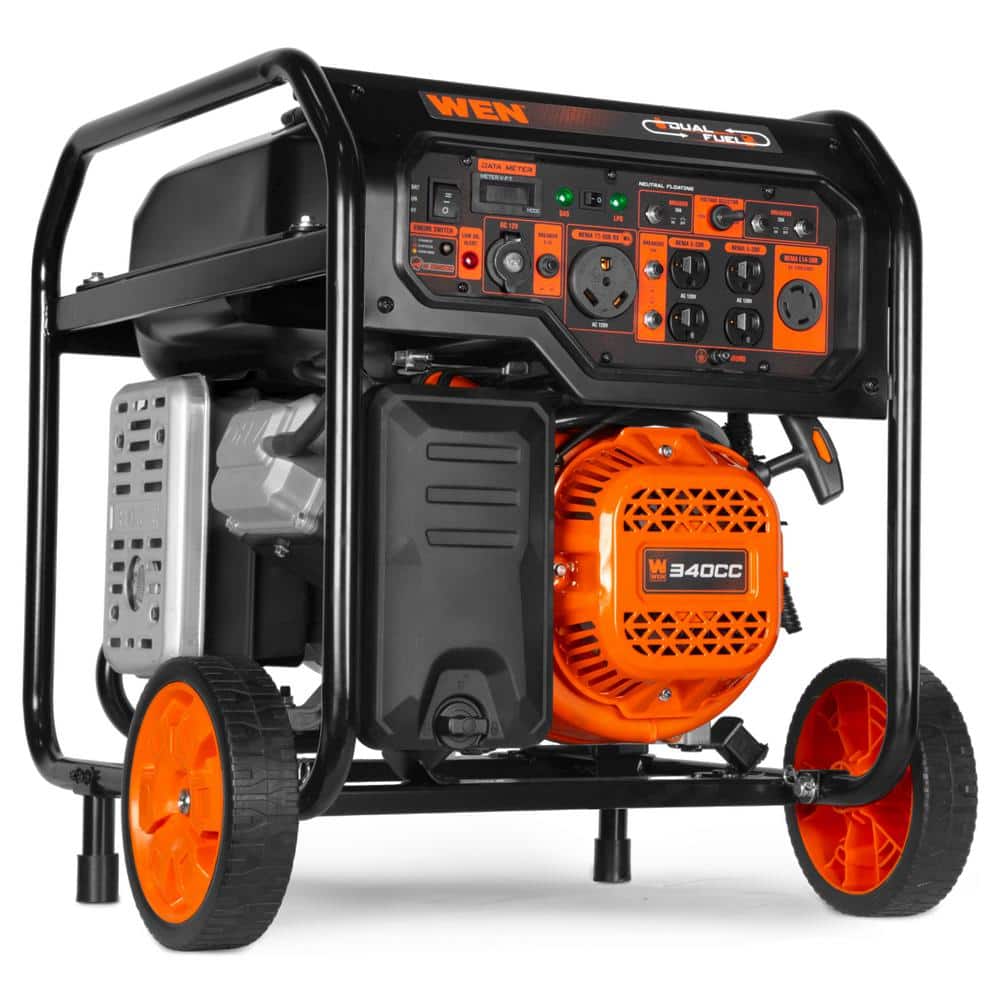
| 70–80 dBA | Conventional portable generator |
| 85 dBA | Heavy traffic; prolonged exposure risk |
Two properties of decibels matter here:
They're logarithmic. Every 10 dBA increase is roughly a doubling of perceived loudness. So a 75 dBA portable isn't "15% louder" than a 65 dBA standby unit — it sounds about twice as loud.
They fall with distance. Sound pressure drops roughly 6 dBA every time distance doubles. A 65 dBA unit at 23 feet is about 59 dBA at 46 feet and 53 dBA at 92 feet. This is why placement beats almost any other noise strategy.
| Distance | 65 dBA unit measures about |
|---|---|
| 12 ft | 71 dBA |
| 23 ft | 65 dBA |
| 46 ft | 59 dBA |
| 92 ft | 53 dBA |
If you can put the generator 40 feet from the neighbor's bedroom instead of 15, you've done more than any enclosure product will do for you.
The exercise cycle is the real issue
Here's what I learned from every noise complaint I ever dealt with: almost none of them were about outages.
During an outage, the whole neighborhood is dark, everyone understands why your generator is running, and half of them wish they had one. Nobody complains.
The complaints are about the weekly exercise cycle — twelve minutes of engine noise on a Saturday morning while the neighbor is trying to sleep in, or during their toddler's nap, every week, forever.
The fix is free. Set the exercise cycle to a weekday mid-morning, ideally somewhere between 10 a.m. and noon. Most people are at work, awake, or out. Avoid:
- Weekend mornings (the classic mistake, and often the factory default)
- Early morning or evening
- Dinner hours
Also consider:
- Quiet-test mode. Several manufacturers offer an exercise cycle at reduced engine speed — noticeably quieter, and it doesn't affect performance during an actual outage.
- Shorter cycles. Some controllers allow shorter exercise durations. Don't go below the manufacturer's minimum, but 12 minutes weekly beats 20.
- Tell your neighbors. Genuinely. "We're installing a generator; it'll run about twelve minutes on Wednesday mornings" turns a mystery noise into an expected one. I've seen this single conversation prevent years of friction.
Placement for quiet
In priority order:
- Distance from bedrooms — theirs and yours. Every doubling buys 6 dBA.
- Put the house between the unit and the neighbor where possible. A building is the most effective sound barrier available and it's already there.
- Avoid hard reflective surfaces. A unit in a corner between two masonry walls reflects sound outward and can effectively raise the level a few dBA.
- Orient the exhaust away from occupied spaces — the exhaust side is the loud side.
- Soft landscaping (shrubs, ground cover) outside the clearance envelope absorbs slightly better than paving. The effect is small but free.
- Respect clearances anyway. 18 inches from the structure, 60 inches from openings, unobstructed airflow.
Reducing noise on an existing installation
If the unit is already in and the noise is a problem, in order of effectiveness per dollar:
Reschedule the exercise cycle. Free, and solves most complaints.
Enable quiet-test mode if your controller has it. Free.
Build a sound barrier wall — but correctly. A solid masonry or dense-composite wall between the unit and the receiver, tall enough to break line-of-sight, placed outside the clearance envelope, can reduce perceived noise by 5–10 dBA. Rules: never enclose more than two sides, never restrict intake or exhaust, and keep manufacturer clearances to the barrier itself.
Anti-vibration pads under the unit if vibration is transmitting into a structure. Modest effect, low cost.
Aftermarket enclosures. Available, and I'm cautious about them. Any enclosure that restricts airflow trades a noise problem for a heat problem — see overheating in hot climates. If you go this route, use products designed for your specific model, and verify operating temperatures afterward. More detail in the sound enclosure guide.
Relocation. Expensive (new pad, gas and electrical runs) but the most effective option if the unit is genuinely in the wrong place.
Ordinances and HOA rules
Many municipalities set maximum sound levels at the property line — often 55–65 dBA daytime and lower at night. A 65 dBA unit at 23 feet may comply comfortably at a property line 40 feet away and violate at 12 feet.
Before installation:
- Check your municipal noise ordinance for daytime and nighttime limits and how they're measured.
- Check HOA covenants, which are frequently stricter than code.
- If you're close to a line, ask your dealer to model or measure expected levels at the boundary.
Most ordinances exempt emergency operation during an actual outage; they generally do not exempt the weekly exercise cycle. Another reason to schedule it thoughtfully.
What to expect, honestly
A modern standby generator at 23 feet is about as loud as a conversation, or a window air conditioner. Inside a house with the windows closed, most owners barely notice it. Outside, standing next to it, it's clearly an engine — you wouldn't hold a phone call there.
If a salesperson tells you it's "whisper quiet," they're overselling. It's a 3,600 rpm engine in a metal box. It's acceptably quiet, it's much quieter than a portable, and with sensible placement and a weekday exercise schedule it will not be a problem for anyone.
Standby generators from the brands comparedAd
Current whole-home listings from Generac, Kohler and Honeywell.
Paid links · As an Amazon Associate, GenDealers earns from qualifying purchases.